|
Starlight ionizes atoms freeing electrons in deep space and solar winds induce a voltage potential powering solar electric currents which transform voltage potential into kinetic energy until electrical resistance of the solar atmosphere transforms kinetic energy into photons, radiated as starlight and transformed into protons composing the solar wind. Photon transformation into protons cools the mantle and protons de-ionize into liquid hydrogen composing the Solar mantle, cooled at the surface by evaporative cooling as liquid hydrogen sublimates into the ionized plasma gas composing the solar wind and interstellar medium escaping from sunspots and coronal holes.
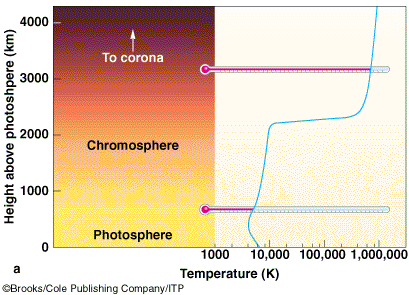
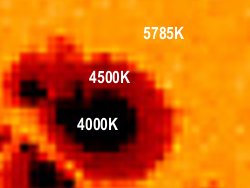
Temperatures in the corona are upwards of 2 million degrees Fahrenheeit, while just 1,000 miles below, the underlying surface simmers at a balmy 10,000 F. How the Sun manages this feat remains one of the greatest unanswered questions in astrophysics; scientists call it the coronal heating problem. The corona floats above the mantle of liquid metallic hydrogen, radiating the ferrite surface below the mantle where photons transform into electron positron pairs and electrons transform into field lines resulting in residual positrons, positrons merge in trios, trios are trapped by transiting electrons and transform into protons. At high photon energy, electron positron pair production is the dominant mode of photon interaction with matter. First observed in Patrick Blackett’s cloud chamber, leading to the 1948 Nobel Prize in Physics. If the photon is near an atomic nucleus, the energy of a photon can be converted into an electron–positron pair:
The Solid Solar Surface Model is based upon observations from the YOHKOH, SOHO and TRACE satellite programs, from spectral analysis data compiled by the SERTS program. This “running Difference” image of the surface was captured by SOHO. This image was taken on May 27th 2005 at 19:13 using the 195A filter that is sensitive to iron ion emissions.
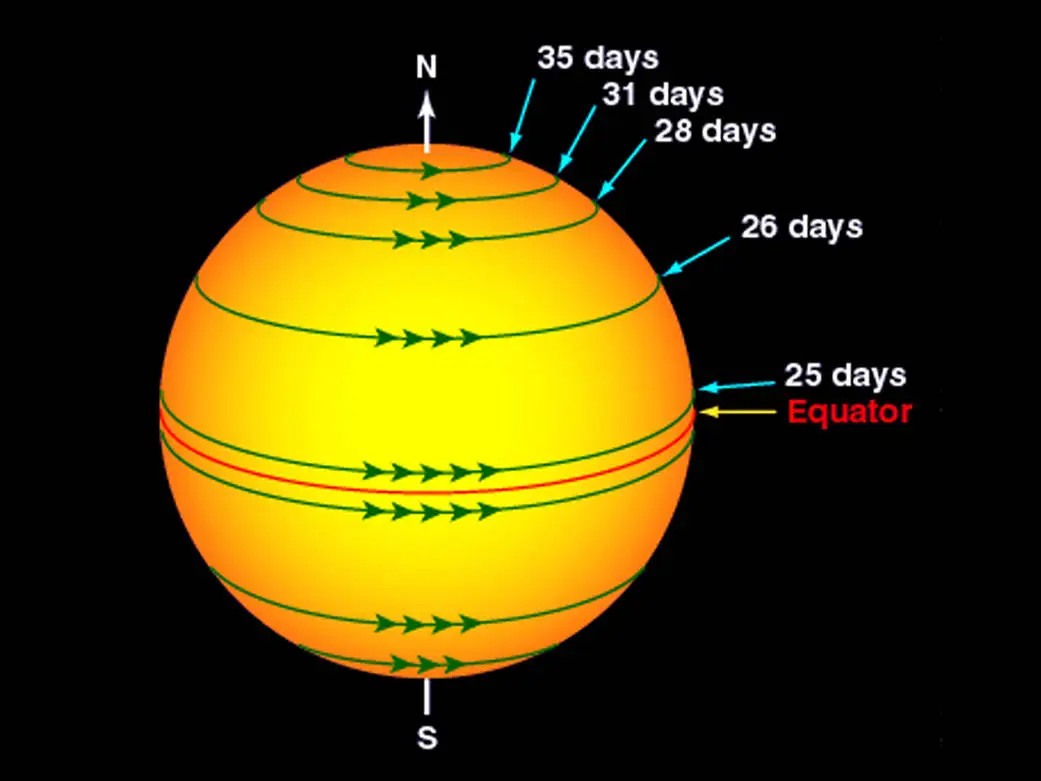
The solar core is a rotating array, of equal radius, ionize spheres which transform the momentum of moving charges into dipole moments and sum of moments induced by core ions is captured by the solar field which powers super rotation of the solar atmosphere and solar wind, in the direction of core rotation.
The Solar field field is twisted into an arithmetic spiral by the the solar wind traveling anti sunward at a rate of 200–800 km/s, powered by electrical repulsion between solar ions and rotating, powered by moments captured by the solar field making a spiral pattern in space.
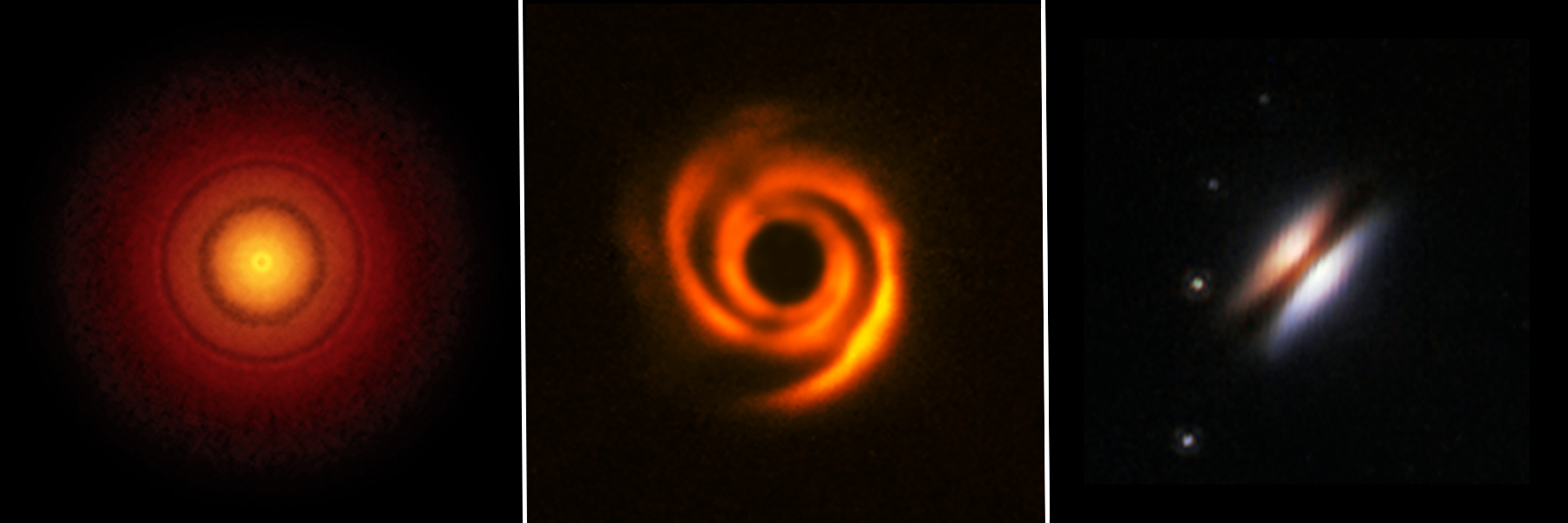
A A proto-planetary disk is a rotating disc of ionized gas and dust accreting matter surrounding a young newly formed star, similar to accretion disks around black holes, except accretion discs are hotter and spin much faster. |
Atoms are Electrons and Positrons