|
Deep space is charged by electron jets from wormholes and black holes, starlight frees electrons, solar winds attract electrons from deep space and solar electric currents transform voltage potential into kinetic energy until electrical resistance of the coronas of stars transforms kinetic energy into photons, radiating as starlight and the ferrite core below the corona.
At high photon energy, electron positron pair production is the dominant mode of photon interaction with matter. First observed in Patrick Blackett’s cloud chamber, leading to the 1948 Nobel Prize in Physics. If the photon is near an atomic nucleus, the energy of a photon can be converted into an electron–positron pair: Photons transform into electron positron pairs at the solar core surface where electrons transform into field lines resulting in residual positrons which merge in trios, three trios are trapped by four transiting electrons and transform into protons which compose the liquid mantle of H2 and solar wind, and interstellar medium of ionized plasma gas. Transformation of photons into protons cools the core and mantle of liquid metallic hydrogen, cooled at the surface by evaporative cooling, as H2 sublimates into ionized plasma gas composing the solar wind and inter-stellar medium.
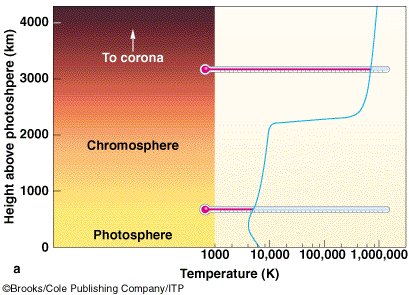
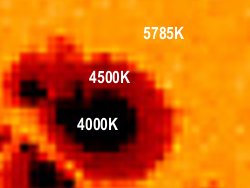
Temperatures in the corona are upwards of 2 million degrees Fahrenheeit, while just 1,000 miles below, the underlying surface simmers at a balmy 10,000 F. How the Sun manages this feat remains one of the greatest unanswered questions in astrophysics; scientists call it the coronal heating problem.
Protons transform in endothermic reactions with electrons, transforming into heavier elements draping the cores the cores of stars and gas giant planets, rotating arrays of equal radius ionized spheres, embedded in fields which capture the repelling force between core ions.When gravitational collapse disrupts the fields of first generation stars the repelling force between core ions are restored and the star explodes in a supernova. The ionized rotating cores of stars and planets transform the momentum of moving charges into dipole moments, and their fields capture the sum of moments induced by core ions which increase velocity of orbiting ions in the direction of core rotation, powering super-rotation of atmospheres and high velocity ring currents around the equatorial planes of stars and planets.
|
Atoms are Electrons and Positrons