|
THE DEEPWATER OCEANS The planetary field captures electrons from the solar wind and electrified weather systems charge the planetary surface which induces a voltage potential between the planetary surface and core where electrons transform into field lines. The voltage potential powers core electric currents from land surfaces through the lithosphere along ferrite conductors and from the oceans through the electrolyte discharge from hydrothermal vents in the deep ocean trenches which fill and fertilize the ocean basins.
At high photon energy, electron positron pair production is the dominant mode of photon interaction with matter. First observed in Patrick Blackett’s cloud chamber, leading to the 1948 Nobel Prize in Physics. If the photon is near an atomic nucleus, the energy of a photon can be converted into an electron–positron pair. At high photon energy, electron positron pair production is the dominant mode of photon interaction with matter. First observed in Patrick Blackett’s cloud chamber, leading to the 1948 Nobel Prize in Physics. If the photon is near an atomic nucleus, the energy of a photon can be converted into an electron–positron pair. Photons induced by mantle heating transform into electron positron pairs at the planetary core surface where electrons transform into field lines resulting in residual positrons, which merge in trios, trios are trapped by transiting electrons transform into protons which transform with electrons into elements composing water and gas saturated magma plumes increasing planetary mass and surface area, as magma upwells and forms new lithosphere between the spreading oceanic plates. OCEAN SPREAD RATES/MILLION YEARS
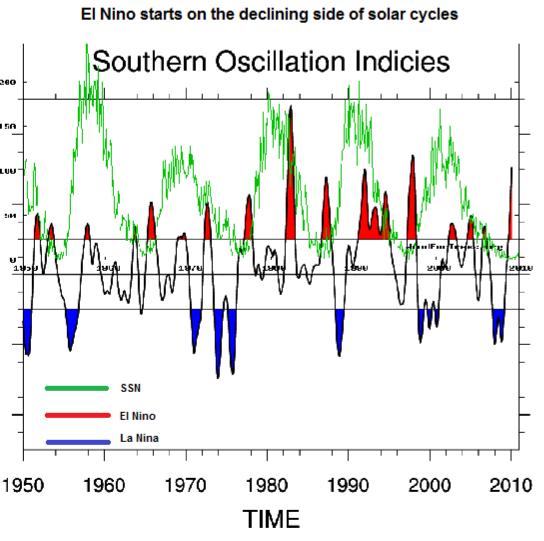
Seawater in hydrothermal vents may reach temperatures of over 700° Fahrenheit. Hot seawater in hydrothermal vents does not boil because of the extreme pressure at the depths where the vents are formed. More frequent geomagnetic storms and electrified weather systems increases the charge of the oceans and the voltage potential across the lithosphere which powers high amperage currents through the discharge which heats the oceans more during the solar maximum, and predictably inducing an El Niño at the lagging end.
A new study shows a correlation between solar cycles and a switch from El Nino to La Nina conditions in the Pacific Ocean. They found all 5 terminator events studied coincided with a flip from an El Nino to a La Nina. They found only a 1 in 5,000 chance all five events would randomly coincide with the flip in ocean temperatures. The El Niño climate phenomenon is “supersizing before our eyes“, the UN has said. The event is near certain to shatter temperature records, according to the latest forecasts the El Niño is likely to be the largest in at least 1,000 years and will pile extra heat into an atmosphere where temperatures are already rising rapidly due to global heating. The combination means 2027 is set to “blow apart” the record and be the hottest year ever recorded. |
Atoms are Electrons and Positrons