|
ORBITAL MOMENTUM
Atmospheric super-rotation is a phenomenon where a planet’s atmosphere rotates faster than the planet’s rotation. This is observed in the atmosphere of Venus, Titan, Jupiter, and Saturn. Venus exhibits the most extreme super-rotation, with its atmosphere circling the planet in 4 Earth days, much faster than its planet’s own rotation in 243 earth days.
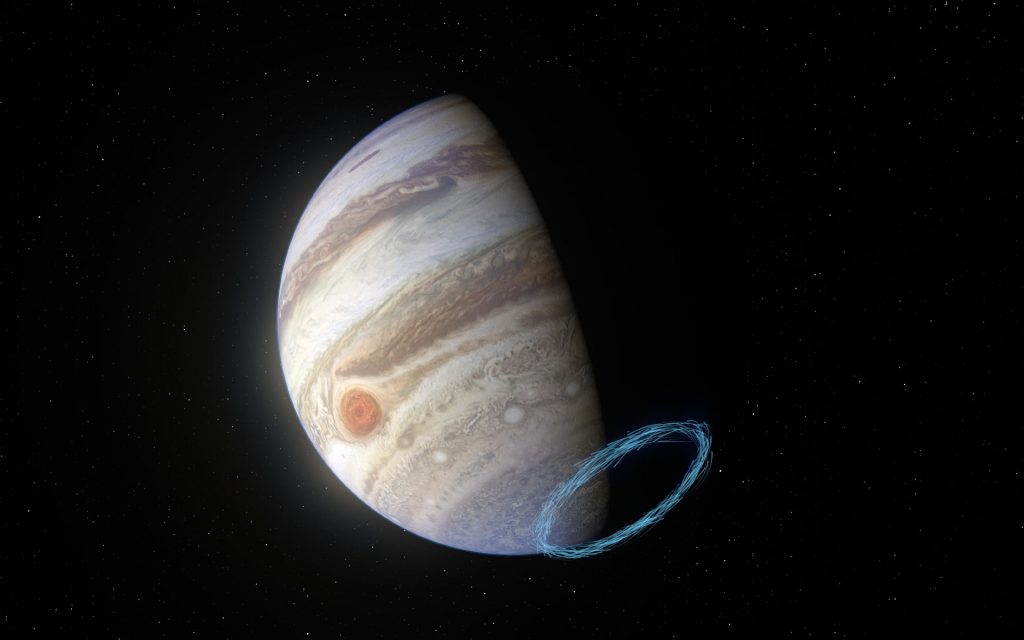
Scientists identify incredibly powerful winds in Jupiter’s atmosphere. The team used molecules exhumed by the 1994 impact of comet Shoemaker–Levy 9 to trace winds in excess of 900 miles per hour, opposite to core rotation, near Jupiter’s poles. Scientists thought they knew the rate at which the giant moon Titan is moving away from Saturn, but they recently made a surprising discovery: Using data from NASA’s Cassini spacecraft, they found Titan drifting a hundred times faster than previously understood — about 4 inches (11 centimeters) per year. The revised rate of its drift suggests the moon started out much closer to Saturn, which would mean the whole system expanded more quickly than previously believed. A proto-planetary disk is a rotating disc of ionized gas and dust accreting matter surrounding a young newly formed star, similar to accretion disks around black holes, except accretion discs are hotter and spin much faster. The three Galilean satellites are involved in orbital resonance, in which the orbital periods of Ganymede, Europa and Io are in a near 1:2:4 ratio and the mutual conjunctions of the Io–Europa pair and of the Europa–Ganymede pair precess around Jupiter at precisely the same rate.
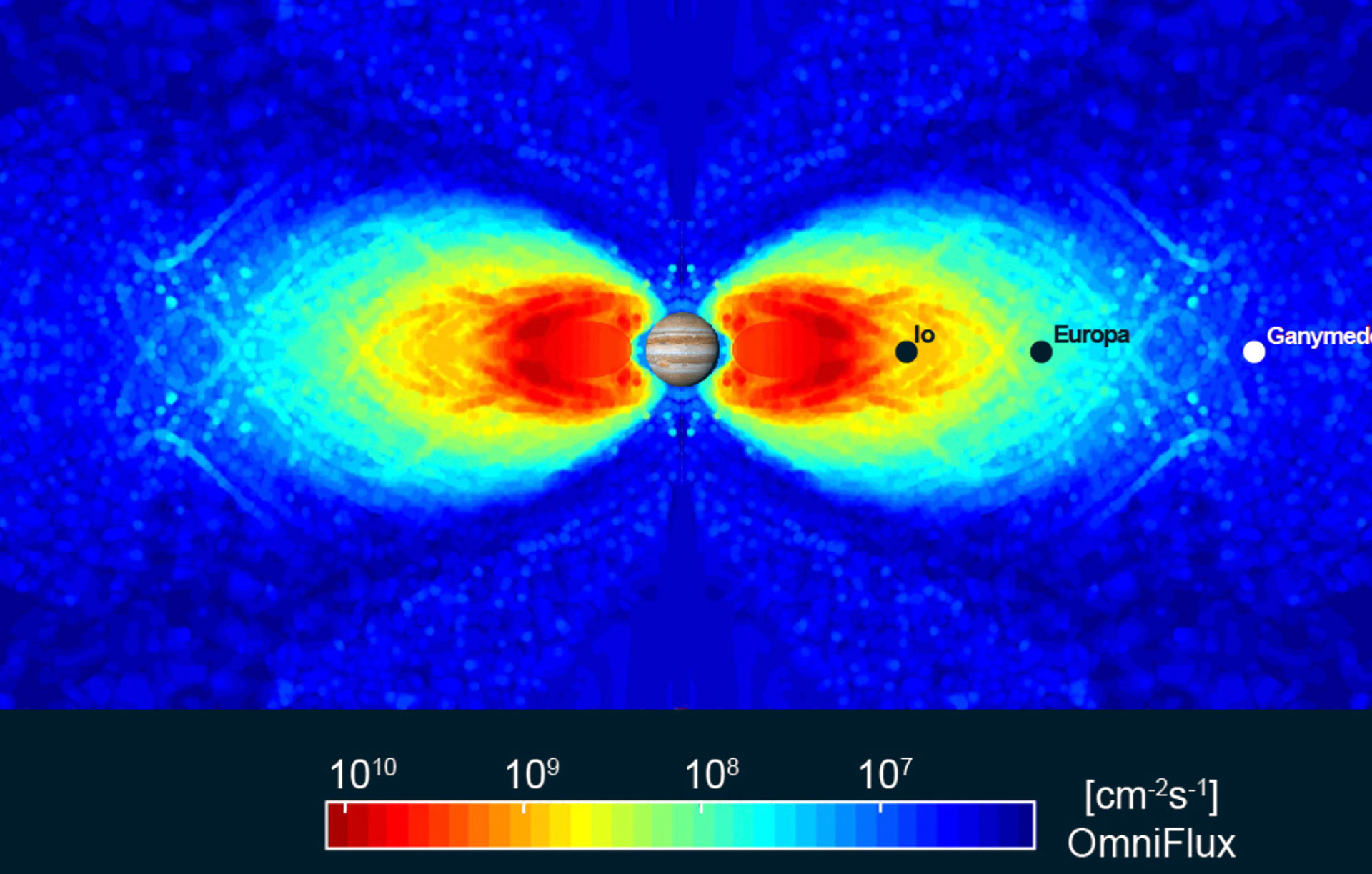
Io and Ganymede are embedded in the high velocity ring current, and block and slow the current which pushes the moons, increasing their velocity, orbital momentum, and radius of their orbits. Io is increasing in mass the fastest of the 3 Galilean moon. One model suggests this resonance was progressively achieved after Io moved outward into a near 2:1 resonance with Europa, and then the Io–Europa pair moved outward until Ganymede was captured into its own near 2:1 resonance with Europa. The six planets of HD110067 form successive pairs of 3:2, 3:2, 3:2, 4:3, and 4:3 resonances, resulting in the closest planet completing six orbits while the outer-most planet does one. |
Atoms are Electrons and Positrons