| According to the framework of Federico Faggin, the biosphere can be described as conscious if it is understood not merely as a collection of organisms, but as a coherent network of interacting conscious entities whose collective organization expresses awareness, meaning, and intention.
In Faggin’s view, each living organism is associated with a conscious entity that exists at a deeper level of reality. The biosphere is the physical interface of an immense community of such entities, all interacting through biological forms. These interactions are not random; they are structured, persistent, and meaningful. The global cycles of life—carbon exchange, oxygen production, food webs, symbiosis—reflect stable patterns of relationship among these conscious agents. The biosphere shows a form of integrated coordination that goes beyond isolated organisms. Forests regulate climate, oceans maintain chemical balance, and ecosystems adapt to disturbances. In the standard scientific view, this is explained through feedback loops and natural selection. But within Faggin’s framework, these same processes can be interpreted as the collective expression of shared meaning and coordinated interaction among conscious entities. This allows the biosphere to be described as a kind of distributed or collective consciousness. Unlike an individual human mind, it does not have a single center or ego. Instead, it resembles a network, where consciousness is distributed across many nodes. The coherence of the whole emerges from the relationships among the parts, much like a mind emerges from the coordinated activity of neurons—except here the “neurons” are living organisms, each linked to its own conscious entity. Finally, the biosphere exhibits something analogous to intention, not as a centralized will, but as a directional tendency toward maintaining and enhancing life. This is visible in the way ecosystems recover, adapt, and reorganize after disruption. This can be interpreted as the collective intentionality of many conscious entities acting in coordination through the physical systems of life.
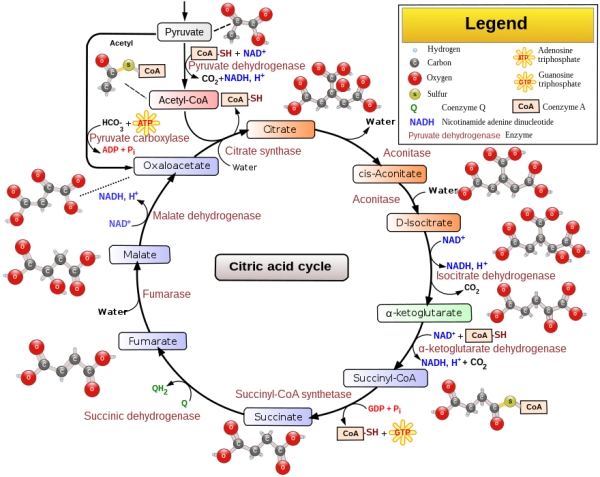
The Krebs Cycle oxidizes glucose derivatives, fatty acids and amino acids to carbon dioxide (CO2) through a series of enzyme controlled steps. The purpose of the process is to collect electrons by oxidizing them, which are transported by activated carriers NADH and FADH2 to the electron transport chain. |
CONSCIOUSNESS